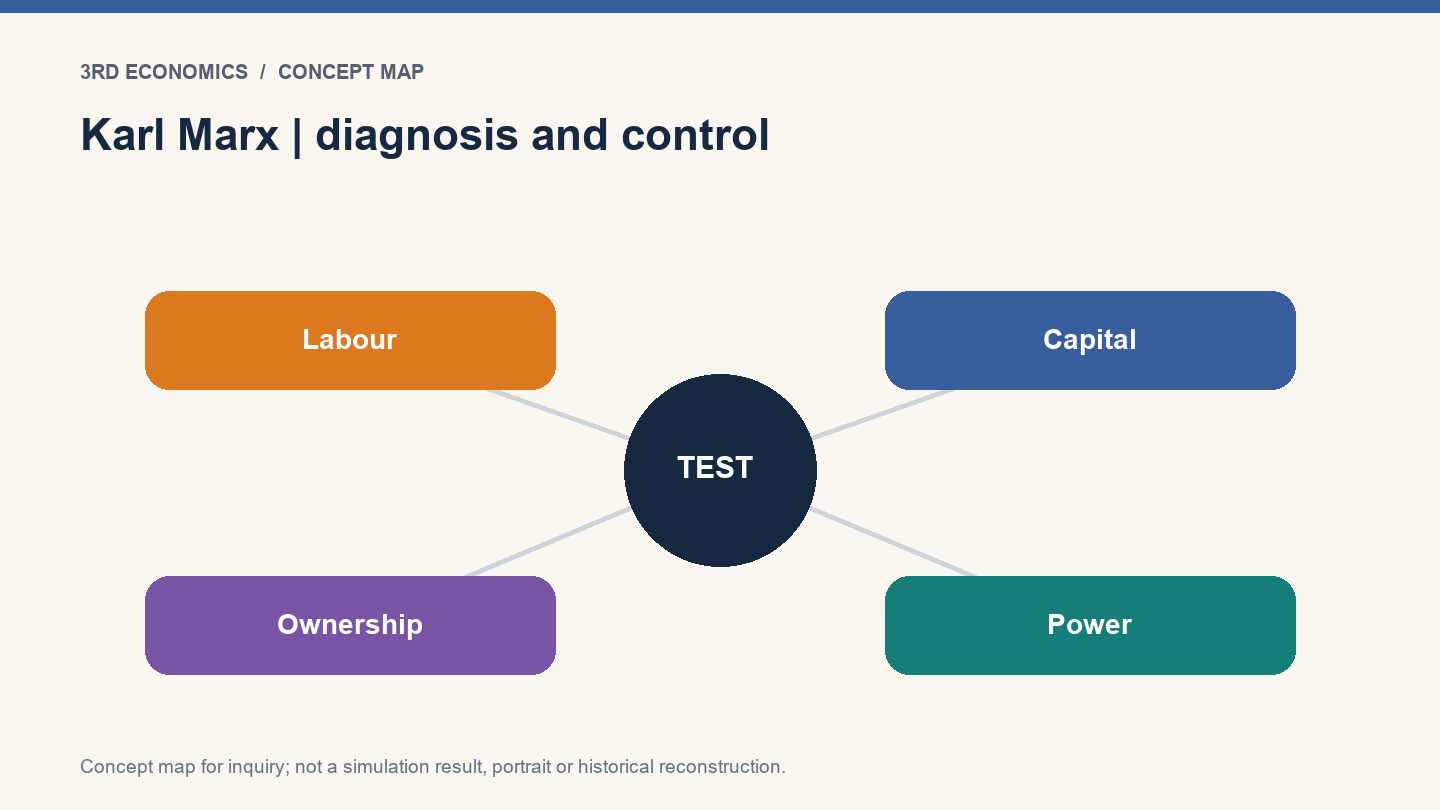
Marx examined exploitation, accumulation and the relations between owners and workers. His criticism of
capitalism cannot be evaluated simply by assuming that every later communist state implemented his writing faithfully. Equally, the failures of institutions acting in his name cannot be dismissed without examining their mechanisms. Key assumption: ownership and control over production shape the distribution of economic power. Assessment: an important explanatory lens; ownership labels alone do not explain all variation in outcomes. Key assumption under examination: collective ownership would overcome domination associated with private capital. Assessment: conditional. State ownership can leave hierarchical control intact, so the identity of the owner does not settle the distribution of agency. The failure question: how can a project for emancipation become a system in which workers cannot refuse, organise independently or challenge allocation? Our test: compare worker control, state control and concentrated private ownership using actual decision rights, exit options, surplus allocation and responses to dissent.