A shortage is a moment, not a destiny
If demand rises while supply cannot immediately respond, prices may rise. But that snapshot does not tell the whole story. Expected demand can attract investment. Larger production runs can reduce unit costs.
New tools, materials and processes can change what is possible. Competition can pass some of those gains
to buyers. This is why 3rd Economics proposes putting dynamic economics at the centre of learning: change is the normal condition, while a frozen system is a special case. Micro and macro describe different scales of analysis; static and dynamic describe how time and adjustment are treated. Our proposed teaching emphasis challenges the order of explanation, not the existence of dynamic work in established economics.
The demand-to-cost loop
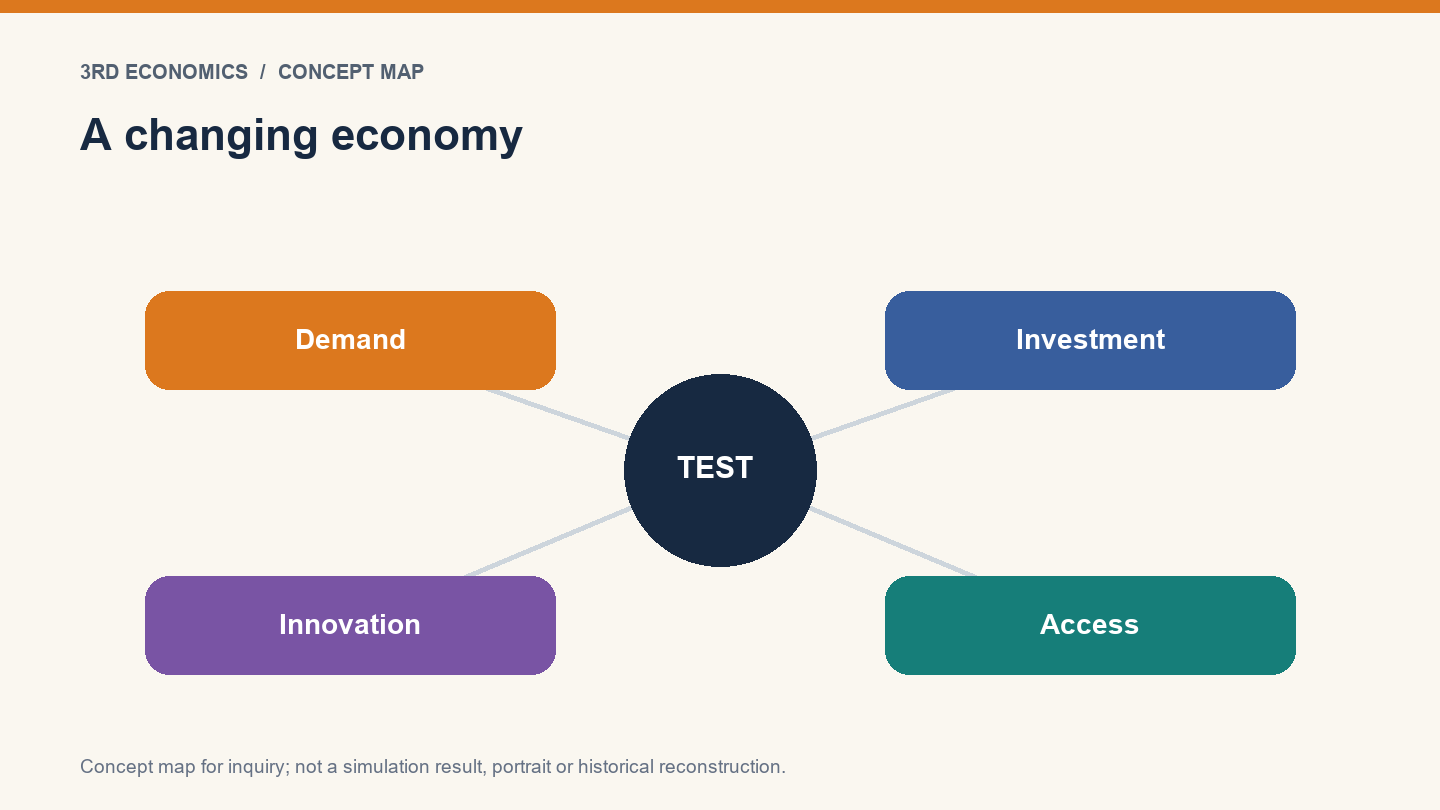
More expected demand can support investment; investment can increase scale and learning; innovation can reduce unit costs; lower prices can widen access and demand. Every “can” matters. Financing constraints, market power, land, energy, ecological limits and failed innovation can interrupt the loop. A useful model must therefore represent both expansion and blockage. It should distinguish production cost from selling price, nominal from real values, and a better product from an unchanged one.
History offers clues—not one universal law
Cloth: mechanised spinning and later developments in weaving changed textile production. Historical work reports a steep decline in real coarse-yarn prices from the early 1780s to 1815. Yarn is an input to cloth, and a price series is not automatically a production-cost series. Steel: the Bessemer process made a major change in the scale and economics of steelmaking. Historical accounts describe dramatic cost reductions, but comparisons depend on process, grade and period. The lesson is a change in productive capability, not a promise that every material becomes cheaper indefinitely. Food: USDA analysis of United States corn farming reports rising yields and declining real production cost per bushel between 1996 and 2016. This is a specific crop and period; food affordability also depends on distribution, energy, waste and income. Mobile phones: a Nokia 1110 was announced at an estimated €65 before taxes and subsidies in 2005; the Nokia 105 was introduced at €15 before taxes in 2013. These are different basic-phone models and launch prices, not audited factory costs. They illustrate widening access, not a controlled cost experiment.
What the Lab will compare
Run a fixed-capacity scenario alongside scenarios with investment, learning, innovation and delayed supply response. Measure affordability, output, quality, resource use, market concentration and transition losses. Ask when higher demand makes goods cheaper—and when it does not.