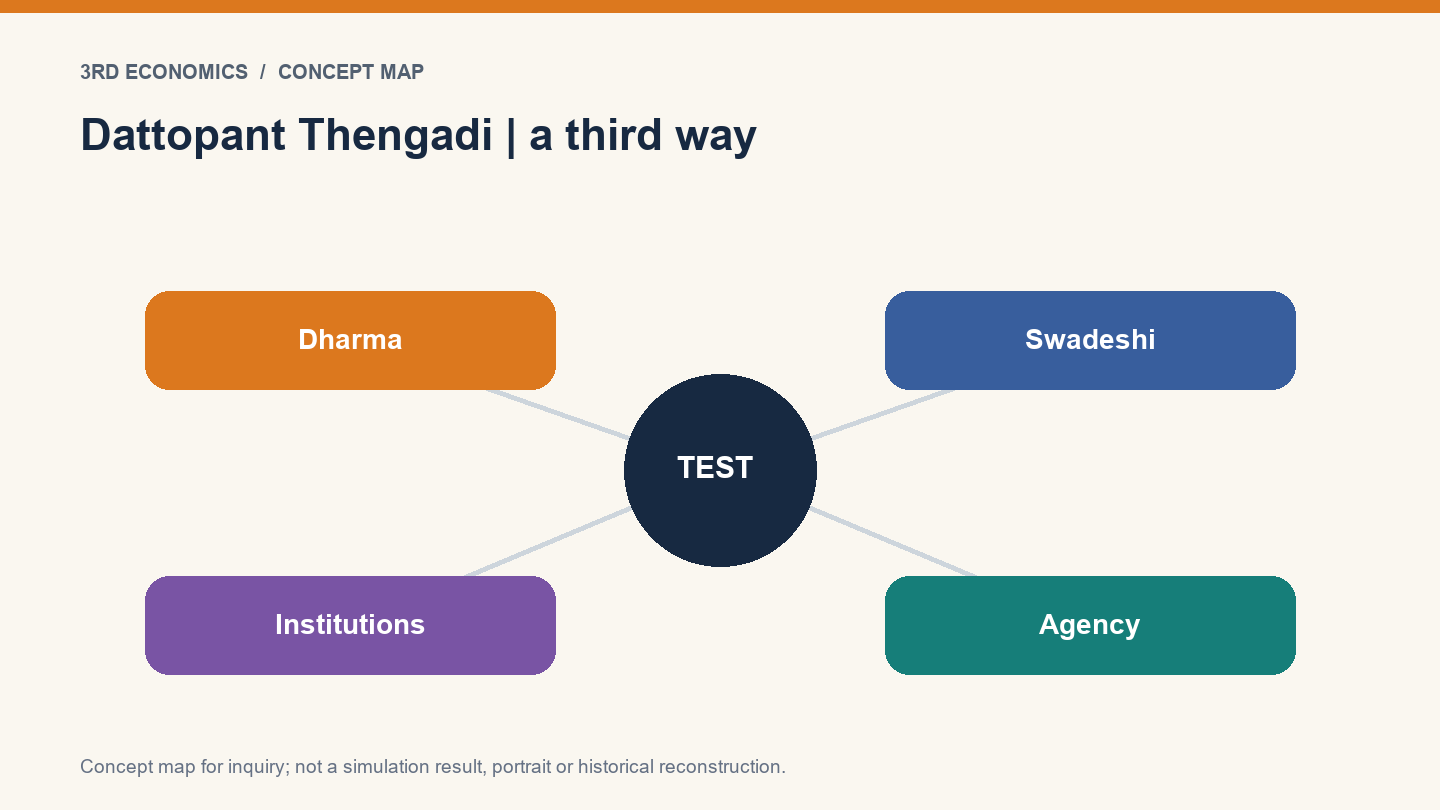
Thengadi’s Third Way challenges the idea that societies must choose between capitalist and communist
frameworks. His thought draws on an Indian civilisational and cultural outlook, including Dharma and
Swadeshi. These commitments should be described in their own context, not stripped away to make a
generic slogan. Key assumption: imported economic categories may be insufficient for a society’s institutions and purposes. Assessment: a useful warning against universal templates; specific alternatives still require explicit mechanisms and evidence. Key assumption: social purpose cannot be reduced to either state ownership or private profit. Assessment: partly a value judgment; practical success depends on how institutions embody it. Question for 3rd Economics: who makes the decisions in the third way, how can those decisions be challenged and how is power prevented from accumulating again? Our test: take a concrete institutional proposal, specify its decision rights and financing, and compare outcomes with competing arrangements.