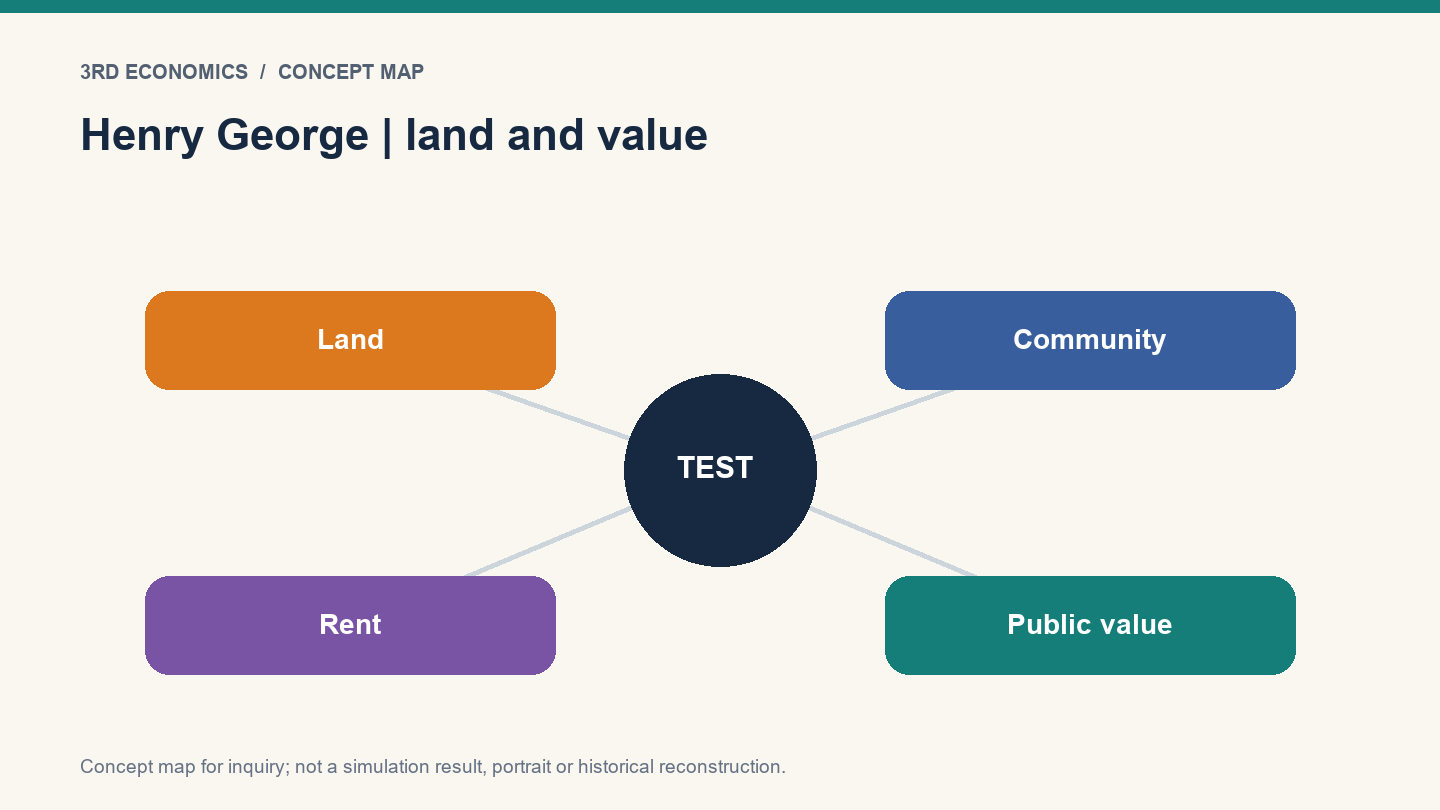
George asked why poverty could persist alongside productive progress. His distinction between
improvements created by effort and the value attached to land remains central to his proposal for capturing land rent for public use. Key assumption: much land value arises from community growth and location rather than an owner’s individual work. Assessment: strongly relevant in many settings, but separating site value from improvements requires careful valuation. Key mechanism: shift public revenue towards land value while reducing burdens on productive effort. The claim that this alone is sufficient for all public needs is not settled by the argument’s appeal. Where the critique bites: land is a bottleneck, and the gains from better infrastructure can accrue to owners rather than residents who helped create them. Where the jury remains out: implementation, valuation, transition losses, political capture and whether the reform sufficiently changes access to credit. Our test: compare land charges, building incentives, rents, development, displacement and concentration under different housing-finance arrangements.