Are we adding epicycles to economics?
For centuries, astronomers modelled planetary motion around an Earth-centred framework. Apparent backward movement could be represented through combinations of circular motion, including epicycles. The models were serious mathematical achievements, but their complexity offers a useful question: what happens when we protect a starting assumption instead of reconsidering it? The transition was not one sudden simplification. Copernicus published his heliocentric account in 1543 and still used circular devices. Kepler’s work in the early seventeenth century described elliptical orbits; Newton’s 1687 synthesis connected motion to gravitation. There was no single day on which humanity finished understanding the whole system.
The economic comparison
3rd Economics asks whether treating scarcity as the organising centre of economic thought can cause us to overlook how production, knowledge and institutions change. A shortage today is not a complete theory of what can be supplied tomorrow. After the Great Depression, Keynesian economics reshaped debates about demand and employment. Later crises produced further disagreements, frameworks and policy responses. Calling every revision an empty patch would skip the evidence; treating every new vocabulary as progress would do the same. The question is whether a change corrects a mechanism or protects an assumption that deserves to be challenged.
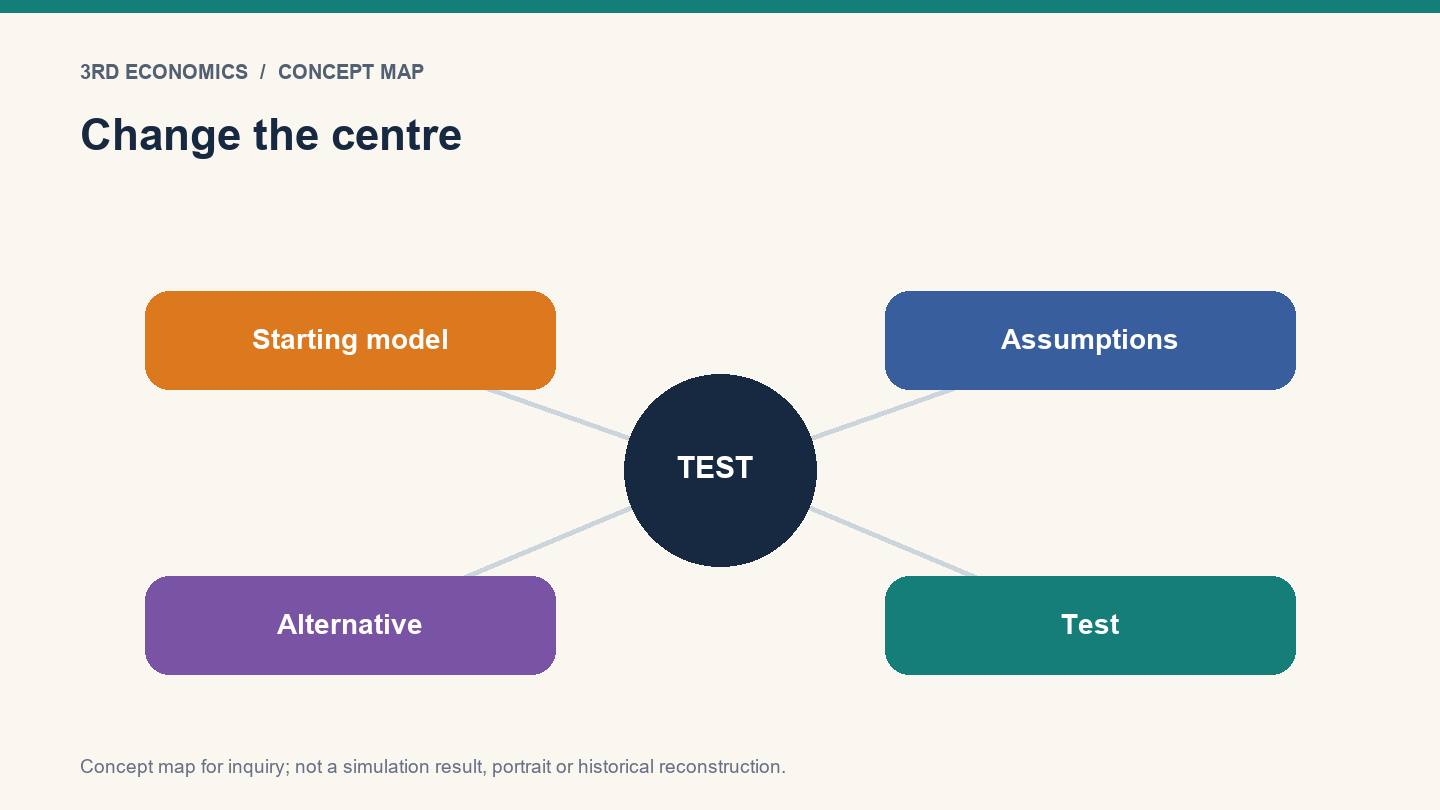
Move the centre, then test the consequences
Our proposal is to scrutinise monetary organisation and concentrated control, while treating economic change as routine. The astronomy comparison is a prompt to investigate. It is not proof that our diagnosis is correct.