Economics should make life easier to understand
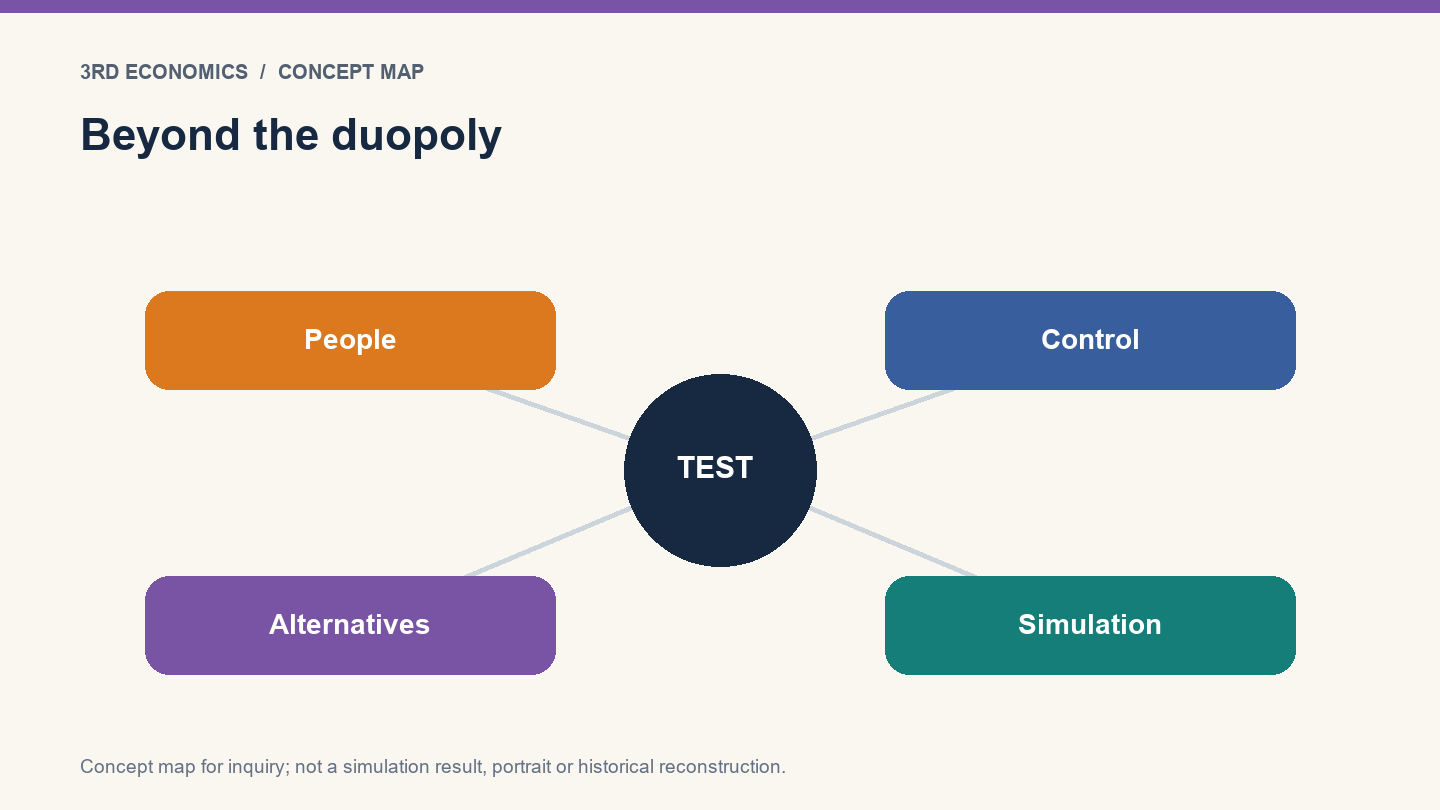
Economics ought to be simple enough to connect to everyday life and logical enough to explain how things change. Yet housing, education, healthcare and financial insecurity remain persistent problems across countries that organise themselves very differently. 3rd Economics begins with a challenge: have capitalism and communism become a duopoly that limits what we are allowed to imagine? Our criticism is that both can preserve concentrated economic and political power even while claiming to oppose each other. We are not asking people to accept another grand promise about the distant future. We want to test what could solve today’s problems. Through AI-assisted simulations, we will compare alternatives, expose assumptions and ask which arrangements make people less dependent on a few powerful institutions.
Duopoly of Capitalism and Communism
Imagine a drinks menu that offers only Pepsi or Coke. You may prefer one, but choosing between them is not the same as choosing everything you could drink. Our economic debate often works like that menu: capitalist or communist, market or state, this camp or that camp. The possibility of a different structure disappears before the discussion begins. 3rd Economics challenges that restricted menu. Who decides what may be produced? Who controls access to money? Who absorbs a failure? Who can refuse, leave or build an alternative? Changing the label above the system does not necessarily change the answers. Pepsi and Coke are used here as a familiar analogy for a restricted choice. The analogy does not claim they are literally the only drinks available or establish a historical conspiracy between economic schools.
The mixed-system question
A mixed system can combine public and private institutions in useful ways. But mixing ownership does not, by itself, distribute control. Our sharper question is whether rival establishments are willing to borrow from each other as long as their position remains secure. Judge the mixture by its consequences: can ordinary people initiate activity, challenge decisions, obtain resources and exit bad arrangements? Or must they still seek permission from the same small circle of decision-makers?
A different centre
Our central diagnosis concerns a monetary system organised around a single currency: a structure that, in our thesis, can make access to economic life depend excessively on institutions that control issuance, credit and settlement. This is a proposition to develop and test. It is not a claim that every country has identical institutions, that every use of a common currency is harmful, or that merely adding currencies removes domination. We need to specify the mechanisms, compare alternatives and examine what new risks each creates.
The practical ambition
What if simple arrangements could substantially improve housing, education, healthcare, transport and income distribution? What would remain for central authority to do? Which decisions require collective judgment, and which could be handled without recurring political bargaining? The Economy Lab exists to investigate those questions. Success means an alternative that works under difficult conditions and improves people’s lives—not winning an argument by choosing convenient assumptions.