Trace the power behind the failure
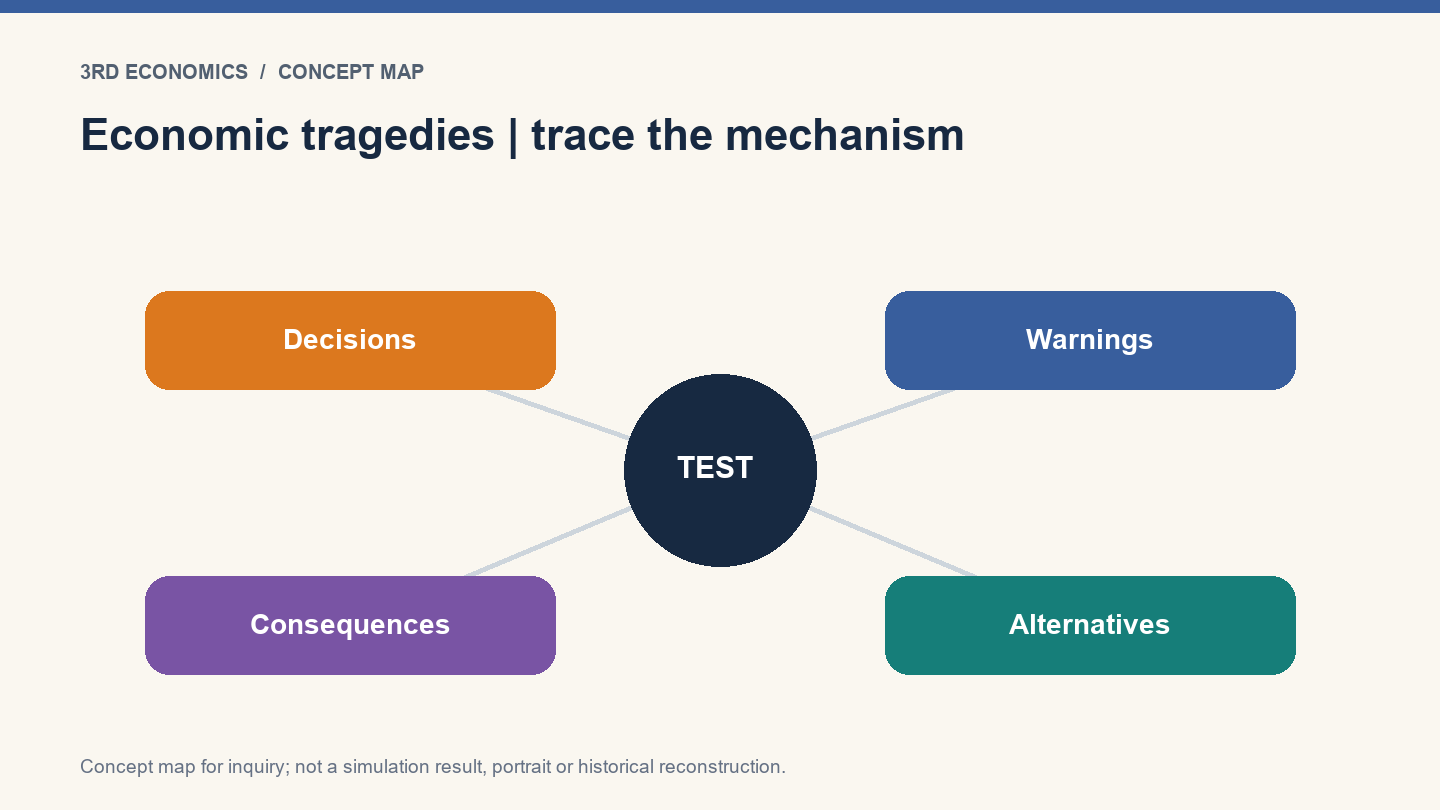
Economic tragedies are not abstract scorecards between ideologies. They involve lost livelihoods, hunger, displacement, coercion and lives cut short. We investigate how decisions were made, whose warnings were ignored, who could leave and who paid for failure. Our organising question is whether concentrated political or economic power created or amplified the harm. The answer must be established case by case. Monetary design, ownership, war, ecology, institutional weakness and international pressures can interact; one explanation must not be imposed on every event.
How each case is read
Begin with a timeline and the human consequences. Map the institutions that controlled resources and decisions. Identify warning signals and the ability to challenge them. Explain competing accounts. Then consider a counterfactual intervention and what evidence would be needed to test it. Counterfactuals are proposals to investigate, not claims that a complex tragedy could certainly have been prevented by one simple change.
Explore further
- Great Depression — 1929 and the 1930s
- Asian financial crisis — 1997–1998
- Global financial crisis — 2007–2009
- Euro-area sovereign debt crisis — from 2009–2010
- Soviet collectivisation and famine — the early 1930s
- Great Leap Forward — 1958–1962
- Cambodia under the Khmer Rouge — 1975–1979
- North Korean famine — the 1990s
- Post-Soviet transition and Russia’s 1998 crisis